Exhibition journal

For this immersive installation the artist Alfredo Jaar invited twenty reportage photographers from across the world to each choose two photographs: the most distressing one they have ever taken and the one that offers the most joy and hope.

Inferno & Paradiso challenges the idea that we have become numb to the many images of suffering we see. Instead, it suggests that the bigger problem is that we often see too many anonymous bodies—people who cannot look back at us or tell us their own story.

The exhibition also asks what we, as viewers, take from these images.

Inferno & Paradiso

It is often said that the continuous bombardment of images of human suffering in the media, has an anesthetizing effect on us, making us emotionally immune to what we see. The exhibition Inferno & Paradiso examines, questions, and finally overturns this notion. As the philosopher Jacques Rancière (The Emancipated Spectator, 2009) stated, there is no excess of images, but a staging of the relationship between those producing the images and what they select for us, because they decide what matters. And the real problem is rather that we see “too many nameless bodies, too many bodies incapable of returning the gaze that we direct at them.”

Alfredo Jaar has invited twenty contem-porary reportage photographers to each select two photographs: the most distressing they have ever taken, and the most hopeful – the image that gave them the most joy. The photographs are presented as analog slide projections in an immersive, enveloping, and unique installation.

These photographers – originating from Ukraine to Argentina, from Gaza to New York, from the Congo to the Philippines – who witness humanitarian and ecological crises, small family joys and immense collective happiness, will guide us like Virgil in Dante’s Divine Comedy, to introduce us to both hell and heaven. How does the photographer face this task? What do we, observers of the joy and pain of others, get from these images? Why can’t we remain immune to the power of photography and the whole spectrum of emotions it conveys?

This work aligns seamlessly with Alfredo Jaar’s multidisciplinary practice, which critically examines the imbalances of power and the sociopolitical divide brought about by globalization and capitalism. Inferno & Paradiso offers a precise and poignant reflection on the role of photographic imagery and the media in today’s society, emphasizing the responsibility of those who work with this medium.

Alfredo Jaar's Biography

Alfredo Jaar (b. 1956, Chile) is an artist, architect, and filmmaker who lives and works in Lisbon after having spent more than 40 years in New York. He is considered one of the most culturally, politically, and socially charged visual artists of our time. In 1994, he travelled to Rwanda to witness the genocide that left a million people dead in the face of the criminal indifference of the so-called world community, an experience which, as he has said, radi-cally changed his life and his practice.

His work has been shown extensively around the world. He has participated in the Venice Biennale (1986, 2007, 2009, 2013, 2026), in the contemporary art exhibition Documenta in Kassel (1987, 2002),

Les Rencontres d’Arles (2013), among others. His work has been published in over eighty monographs, including at the Musée Cantonal des Beaux-Arts in Lausanne in 2007. Alfredo Jaar received the Hasselblad Award in 2020 the IV Albert Camus Mediterranean Prize in 2024 and was awarded the Prix Pictet in 2025.

His work can be found in the collections of MoMA and Guggenheim Museum, New York; Art Institute, Chicago; TATE Modern, London; Centre Georges Pompidou, Paris; Centro Reina Sofia, Madrid; MAXXI and MACRO, Rome; MCBA, Lausanne, and dozens of institutions and private collections worldwide.

The Photojournalists' Choice

SAMAR ABU ELOUF (1983)

Mahmoud Ajjour, a 9-year-old boy, lost both of his arms after being struck by a missile while fleeing his home. When he woke up and began to understand what had happened to him, he said to his mother, "How will I hug you now?" Mahmoud is currently receiving medical treatment in Qatar.

Doha, Qatar, June 28, 2024.

Rawan Qudeih, 15 years old, wears traditional Palestinian attire and carries wheat stalks on her head during the wheat harvest season. She was participating alongside farmers in harvesting wheat from the agricultural lands of Khuza'a.

East of Khan Younis city in the southern Gaza Strip, June 6, 2020.

My entire life in the city of Gaza has truly been both an inferno and a para-dise. Following the invitation to take part in this project, I began to think about the images I would choose from an archive that spans over 14 years, filled with contradic-tions and emotional depth. Between the extremes of suffering and beauty, I chose these two images that, to me, express life and survival, darkness and light.

The image of young Mahmoud Ajjour embodies the true inferno of our time, and particularly the inferno that Gaza lives through every day. He once lived the simple paradise of having two function-ing arms, he felt their blessing, their use-fulness, and now he is deprived of them, trapped in darkness, searching for a way to live again, to one day wear prosthetic limbs. The second image is of Rawan Qudeih, a girl who is not just harvesting wheat; she’s harvesting our collective memory. Today, in the midst of famine affecting the entire population of Gaza, a single wheat stalk has become a dream, a paradise, that keeps people alive.

The contrast between the two images reminds us that life is always full of contradictions, and that images, no matter how straightforward they may appear, often carry within them deep layers of meaning.

Biography

Samar Abu Elouf (b. 1983) is a Palestinian freelance photojournalist. Since 2010, she has worked as a freelance photojournalist on assignment for Reuters and The New York Times. She documented the 2018–2019 Gaza border protests. She also covered the 11 days of fighting between Israel and Hamas. Previously based in Gaza City, Abu Elouf puts herself at the center of danger to chronicle how conflict and need affect people in her community.

In late 2024 she was forced to evacuate her home.

LYNSEY ADDARIO (1973)

Ukrainian civilians, while being shelled by Russians, try to make their way out of the village of Irpin as Ukrainian soldiers try to hold back Russian forces from entering Kyiv.

Ukraine, March 6, 2022.

A wedding in Baghdad. The long stretch of relative calm in Baghdad is sparking a marriage boom. Not only do more people appear to be hitching up, newlyweds are throwing lavish wedding parties like those that were once a mainstay of the Baghdad social scene.

Baghdad, Iraq, 2010.

At the start of the Russian invasion of Ukraine in 2022, I was on assignment photographing a civilian evacuation route outside Kyiv. Mortar fire drew increas-ingly close, and then one struck about 30 feet from where I stood, killing a mother, Tetiana Perebyinis, and her two children, aged 9 and 18, as they fled. I had just been sprayed with gravel—close enough to be killed. As a mother myself, I try to stay focused while working, but when I saw the small moon boots and puffy coat, I thought of my own children. I had to take this photo. This is a war crime.

Differently, I’ve chosen to show a pho-tograph taken in Baghdad in October 2010, during the wedding of the young couple Heelan Muhammad and Husham Raad. The joyful two-day celebration sharply contrasted my 2004 visit, when Iraq was overwhelmed by violence—daily explosions, killings, and kidnappings (I, myself, was kidnapped near Fallujah that year). By 2010, hope had returned; people were out and about again, weddings were common, and young Iraqis felt safe enough to plan for the future.

Biography

Lynsey Addario (b. 1973) is an award-winning American photojournalist who has spent over two decades documenting conflict, humanitarian crises, and wom-en’s issues worldwide—particularly in the Middle East and Africa—for The New York Times and National Geographic Magazine.

A MacArthur Fellow and two-time Pulitzer Prize winner, she is the author of the best-selling memoir It’s What I Do (Penguin, 2015) and the photography monograph Of Love and War (Penguin, 2018).

MOTAZ AZAIZA (1999)

Nada, a young Palestinian girl, was trapped under the rubble of her home after it was bombed by an Israeli air strike.

Gaza, October 31, 2023.

On the morning of Eid a girl dons her traditional Palestinian dress.

Gaza, April 2023.

As I wandered through the crowd on the first day of Eid Al-Fitr, I came across a beautiful little girl in her traditional Palestinian dress. Her smile, the colors, and the good light every photographer needs made the moment feel like paradise. This photo is more than a memory—it holds joy, love, tradition, and the warmth of Eid in a single frame. It reminds me of how full of life and happiness my homeland once was. It captures a glimpse of a morning when hope lived, and laughter filled the streets. Even in the hardest circumstances, beauty still finds a way to shine. Gaza, despite everything, holds the spirit of life deep in its heart.

But everything changes when a geno-cide occurs. Documenting Nada while she was still under the rubble is haunting. The weight of seeing her trapped, of capturing her destroyed home, leaves a scar that may never heal. I wish I had photographed her smiling, full of life. Instead, I took a photo darker than words can describe, a reflec-tion of our pain in an inhumane world.

Biography

Motaz Azaiza (b. 1999) is an award-winning Palestinian photojournalist whose work reveals the struggle of his people for dignity.

His coverage of the Gaza war has drawn a large social media following. The photo he captured of a girl trapped in rubble after an Israeli air strike was named one of Time’s top 10 photos of 2023. In the same year, he was named Man of the Year by GQ Middle East.

In 2024 he was included in Time’s list of the 100 most influential people.

VÉRONIQUE DE VIGUERIE (1978)

Carnival in a favela in Rio de Janeiro. Masked men, members of a local gang in control of the favela, patrol the narrow streets. A young child disguised as a kitten passes by on her way home.

Rio de Janeiro, Brazil, March 2019.

A balloon vendor riding his bicycle, nearly hidden beneath a vibrant sea of colors.

Pul-e-Charki, Afghanistan, December 2023.

In the narrow alleyways of Rio de Janeiro, masked men bearing rifles stand over a child during Carnival—a twisted dance between festivity and fear.

Thousands of miles away, on a dusty Afghan road to Jalalabad, a balloon vendor pedals through the morning light, his fragile bicycle overflowing with bursts of color. These two moments, though worlds apart, echo the paradox of human existence. One scene reveals a hell masked as celebration; the other, a fleeting paradise carved out of hardship. Both speak to survival, contrast, and the human spirit’s search for dignity amid chaos. This is “hell/ paradise” where innocence and menace coexist, and where joy floats, even if only temporarily, through shadows.

Biography

Véronique de Viguerie (b. 1978) is an award-winning French photojournalist driven by a desire to capture the world in all its complexity. With this work, she chooses to see life in color and nuance—refusing the binary lens of black and white.

Her images explore the fragile border between paradise and hell, revealing the beauty, contradictions, and resilience within the most unlikely places.

MAXIM DONDYUK (1983)

In the aftermath of Russian shelling near a metro station, a woman collapses in grief beside the lifeless body of her husband.

Kharkiv, Ukraine, 2022.

A silent winter landscape where nature reclaims what was once lost.

Chernobyl Exclusion Zone, Ukraine, 2018.

These two images are reflections of inner states I have lived through and witnessed. The first—a woman mourning her husband, killed by a missile near a metro station—is inferno. Not only for its violence, but for how the desire for power, dominance, and land turns into destruction and death.

The second photo, from my long-term Chernobyl project, shows a landscape emptied of people, where nature slowly reclaims what was lost. Here, I find paradiso—not in joy, but in stillness, where the mind is no longer ruled by craving. In this quiet, there is no struggle, no desire to possess. After years spent witnessing suffering, I’ve come to understand: inferno is attachment, paradiso is letting go. Peace is found not in pleasure or pain, but in a balance where the mind is free from craving.

These images come from different projects, but together they form a single meditation—on time, loss, and the possibility of inner peace.

Biography

Maxim Dondyuk (b. 1983) is a Ukrainian photographer and artist who combines fieldwork, historical inquiry, and personal reflections with the medium of photography, video, text, and archival materials. His interests include history, memory, conflict, and their enduring impact. His projects examine the meanings of war and nuclear energy.

He is a recipient of the W. Eugene Smith Grant and Prix Pictet. His work has been shown at the Musée d’Art Moderne, Paris, and Somerset House, London.

ABDULMONAM EASSA (1995)

Two Syrian sisters reunite in tears surviving an airstrike.

Hamouria, Eastern Ghouta, near Damascus, January 9, 2018.

A Sudanese boy dives into floodwaters in al-Kalakla, during heavy flooding.

al-Kalakla, southern district of Khartoum, September 7, 2021.

Heaven and hell on this earth are not always distinct opposites. Often, they intertwine in the details of the events we live through.

Hell reveals itself in moments like the one when the Abbas family lost most of its members—killed in a bombing by the regime forces of the dictator Bashar al-Assad. Yet even in the heart of devastation, a glimmer of life persists—perhaps a trace of heaven. The two sisters who survived that bombing carry the scars of fear on their bodies, but in their eyes shines a strange determination to hold on to life.

In contrast to this scene of death, another image emerges—this time in the heart of African nature: a Sudanese child leaps from a tree into the waters of the Nile, laughing, savoring the heat of the day, as if momentarily escaping the harshness of daily life. But behind that smile lies another tragedy. The same waters that offer joy and relief have forced dozens of families to flee their homes, swallowed by the floods.

Endings and beginnings, death and survival, memory and wonder—all coexist.

Biography

Abdulmonam Eassa (b. 1995) is a Syrian photojournalist who began his career in 2013 during the siege of Eastern Ghouta. Self-taught, he uses photography to document the lives of ordinary people in war and post-war zones. After moving to France in 2018, he covered the YellowVest protests.

He later reported from Sudan, Ukraine, Turkey, Syria, and Chad. In 2024, following Assad’s fall, he returned home. His work earned the ICRC Humanitarian Visa d’Or (2019).

DONNA FERRATO (1949)

Garth cornered Lisa in their bathroom, hunting for his cocaine pipe. "I have hidden it," she said, "to save our marriage." He ransacked the bathroom searching frantically for the pipe. Suddenly he hit Lisa. When he finally found the pipe, he smashed it. "I had my own all the time," he said smugly. "I just wanted to teach you a lesson."

New Jersey, 1982.

Fanny giving birth. It took 6 hours till the boy was born. Fanny revealed who helped her get through it. "I was terrified of the pain of childbirth until my mother-in-law said, 'It's the most beautiful pain a woman will feel.'"

New York, 2013.

In the first picture, there is a woman in her own home, trapped in domestic vio-lence. Across the world, women are not safe, even in the spaces meant to shelter them. The home, once a sanctuary, has become a site of violence for countless women and girls. Beaten, strangled, raped by husbands, boyfriends, or family members, these crimes go unacknowledged and unpunished. In the U.S. in 2025, terminat-ing a pregnancy can carry harsher penalties than the rape that caused it. This is hell: a world where gender-based violence is protected, even legislated.

In the second picture, a woman gives birth. It’s my daughter in labor at home, as she births her child in her own time, her own way. Her husband is beside her, not controlling, simply present. This is not performance. This is trust. The pain is real, but so is the ecstasy. This is heaven, not per-fection, but freedom. This is what becomes possible when women are safe enough to be powerful.

These photographs are not opposites. They are part of the same world. One reveals the violence that persists when power is abused. The other, the beauty that emerges when power is returned. Between them lies a choice: What kind of world do we want to create?

Biography

Donna Ferrato (b. 1949) is a fearless photojournalist who redefined how the world sees domestic violence. Her iconic book Living With the Enemy sparked global change. From her book, Holy, to a public installation, The Wall of Silence, she wields her lens for justice.

Honors include a 2025 honorary doctorate from John Jay College of Criminal Justice, the W. Eugene Smith Grant, RFK Award, IWMF Courage Award, and Tribeca Film Festival Artist of the Year.

JOHANNA-MARIA FRITZ (1994)

Men unload bodies from a mass grave into a refrigerated truck in Bucha. The town was occupied by Russian forces for about 33 days. During this time, an estimated number of 501 civilians were killed, many showing signs of violence such as gunshot wounds and torture.

Bucha, Ukraine, April 7, 2022.

In 2022, the day before her consecration, Bernadette Lang (30) bathes in the Austrian Fuschlsee. A consecrated virgin is a woman in the Catholic Church who has chosen to remain a virgin for her entire life as a sign of her total dedication to Christ.

For me, these two images stand as opposites of human experience.

In Bucha, residents lived through over 30 days of horror. We arrived on the day of liberation. Bodies lay scattered on the streets, in different stages of decay. In base-ments, we found tortured and executed civilians. Bullet holes marked walls under which people were shot. Cars with “children” written on them stood burned and riddled with bullets. Gardens held no flow-ers, only graves. That was the inferno.

In contrast, Bernadette bathing in the lake feels like a moment of pure paradise. Her body floats in soft water, surrounded by light and silence. It is not about escape, but about the possibility of peace.

Biography

Johanna-Maria Fritz (b. 1994) is a German photographer and visual story-teller. She lives between Germany and Ukraine. Her work has been exhibited in museums, galleries, and festivals around the world.

She works for international media and focuses on social inequalities, conflict, and the impact of patriarchal power structures.

Olivier Jobard (1970)

Two men drowned after a dinghy full of migrants capsized during a failed attempt to cross the Atlantic Ocean between Morocco and the Canary Islands in September 2004.

Kingsley Kum Abang, a 22-year-old from Cameroon, stands with other migrants on a hill in the Gurugu Forest, Morocco, gazing toward Melilla, the neighboring Spanish enclave. Morocco, July 2004.

In 2004, I took the migration route alongside Kingsley, a 22-year-old from Cameroon. His journey to Europe stretched over 10,000 kilometers, through seven countries, and lasted nine grueling months. Along the way, Kingsley endured both physical and psychological hardship. He crossed the Sahara Desert, suffering from extreme hunger and thirst. Smugglers threatened him, stole from him, and treated him with cruelty. In Morocco, things wors-ened—he was arrested, beaten, and sub-jected to inhumane conditions in deten-tion. His clandestine journey became a brutal odyssey in search of what he hoped would be a better life.

When Kingsley finally reached the border between Morocco and Melilla, he saw European soil for the first time. The “promised land” was right there—close, yet unreachable. Towering barriers marked the edge of Europe, turning the continent into a fortress. With no way through, Kingsley made the desperate decision to attempt the crossing by sea, hoping to reach Spanish territory. To chase his “paradise,” he had to pass through a living hell.

Biography

Olivier Jobard (b. 1970) is a French photographer represented by the MYOP agency and a filmmaker. At the age of 20, he was thrown into the war of his generation, the Balkans conflict. Then he traveled through the world’s violent regions.

In France, in Sangatte, he was deeply moved by the courage of the refugees, coming from countries whose crises and conflicts he had covered. For the past 25 years, Jobard has chosen to focus his work on migration issues.

BÜLENT KILIÇ (1979)

US air forces hit the position of Islamic State members as one of them is visible near the explosion at the Turkish Syria border next to the Syrian city of Kobane.

Syria, October 23, 2014.

Young shepherd dogs take care of a sheep that got sick after a snake bit her. Perhaps this is the first lesson of when they grow up.

Dersim mountains, Turkey, July 31, 2021.

Shortly before I took the explosion photo, I learned that a strategic hill on the Turkish-Syrian border had been taken from Kurdish fighters by Islamic State militants. We positioned ourselves right across from this hill, and I remember saying to my cameraman friend, “Just think about what if the coalition air force hit the hill right now.” Yes, a few seconds after I said that a fighter jet from the American air force hit the very hill. You decide whether this photo is heaven or hell. The fact that the militants of an organization that killed thousands of people, kidnapped women, and committed great crimes against humanity were hit with a mini atomic bomb, left my emotions in limbo.

Kurdish villagers who call themselves Savaks, go up into the Munzur Mountains in the spring and make a living by selling the cheese they produce. Sometimes floods come, sometimes bears enter the cheese warehouses. It takes 15 days for them to return from the plateau to their villages; they live high up all summer long.

Life is an endless thing and we are actually right in the middle of it, in fact there is heaven and hell in this world, turning it into heaven sometimes depends on our per-spective. Most of the time it is not in our hands.

Biography

Bülent Kılıç (b. 1979) is an award-win-ning photojournalist working around Europe and the Middle East. He started photography in the early 2000s, and he calls himself the last generation of analogs. He covered the Syrian war from the beginning. When Kılıç arrived at the Syrian border with Turkey in 2012, he knew that this was the border of his life, and nothing would be the same as before.

He has covered Iraq, Ukraine, and Afghanistan.

ALICE MARTINS (1980)

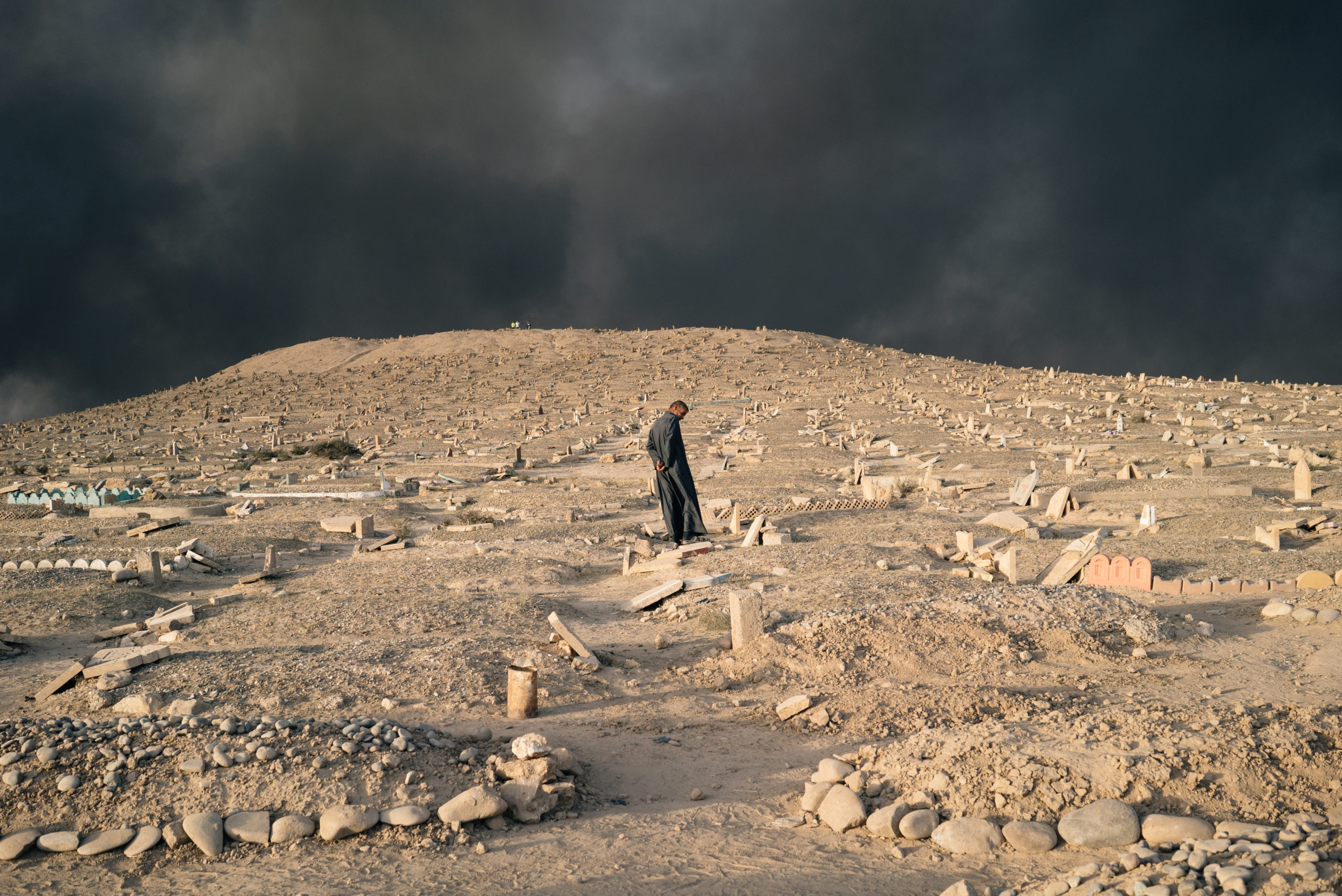
An elderly man stands at the Qayyarah graveyard as black smoke from oil fields set ablaze by fleeing ISIS militants fills the sky. The militants destroyed all tombstones, which they considered "un-Islamic", while they controlled the city.

Qayyarah, Iraq, October 20, 2016.

Abu Tayf, the commander of a Free Syrian Army battalion in Raqqa city, holds a newborn child and recites the adhan—the first words a child should hear according to Islam. The child was brought to him by a local man who found the newborn abandoned in a public garden.

Raqqa, Syria, July 13, 2013.

What can be more brutal than war, a campaign of relentless violence and suffering entirely orchestrated by humankind? There is nothing natural about it, and yet it seems to be an inextricable part of our existence in the world as we know it. What motivates those in power may differ vastly from what motivates the foot soldiers on the ground, and to each conflict there’s a unique set of circumstances. But what all wars have in common is that they bring out the very worst in humanity. In spite of that, the thing that surprised me at first, and the thing that allows me to retain a sense of hope and relief amid the horrors I witness as a photojournalist reporting on war, is that they also bring out the best in humanity. There isn’t much in between—war is a realm of extremes.

In the image of the Iraqi man standing listless amid broken tombstones under a black sky, the bleakness of it all represents hopelessness under man-made dark clouds and the desecration of the place where the deceased were laid for their final rest.

In the image of the rebel commander gently holding a newborn who was rescued from certain death after being abandoned under the blazing summer sun, a reminder of the preciousness and fragility of life left the armed men in the room stunned and in awe.

Biography

Alice Martins (b. 1980) is a Brazilian photojournalist primarily reporting on humanitarian crises and conflict in Syria, Iraq, and Ukraine. Born in 1980 and raised by the Atlantic Ocean in southern Brazil, she started photographing with a Kodak Instamatic camera in 1989.

Her work has been featured in Harper’s, Stern, The Smithsonian and Der Spiegel, among other publications. She is a frequent contributor to The Washington Post.

LORENZO MELONI (1983)

Body of an Islamic State sniper killed by an Iraqi sniper while holding a position inside a civilian home.

Mosul, Iraq, May 2017.

Night view of a salt flat. A reddish water path runs through crystallized salt in an artificial industrial landscape.

Salin-de-Giraud, France, July 2023.

Extract from a letter to Alfredo Jaar: “What is this Hell and Paradise? My images cannot illustrate my hell or my paradise; rather, they stand as anomalies within a binary structure of representation, which I question.

The body of a jihadist killed in battle: paradise for him, hell for the viewer?

A landscape as a threshold—closed, unreachable. Like Virgil, we remain on the edge, unable to cross into what we call divine.

In a world that simplifies and polarizes, refusing clear-cut answers is not a form of evasion, but a form of honesty. For this reason, I do not present icons of salvation or pain, but images that resist univocal interpretations. Hell and paradise are not here—not in my photographs, nor in history.”

Biography

Lorenzo Meloni (b. 1983) is an Italian photographer who has spent over a decade documenting conflicts and questioning how they are represented. He uses fragmented narratives to explore how visual accounts of contemporary history are constructed.

His monograph We Don’t Say Goodbye documents the rise and fall of the Islamic State. A member of Magnum Photos agency, his work is widely exhibited and held in public collections.

FINBARR O’REILLY (1971)

Ethiopian government soldiers, captured by the Tigray People's Liberation Front, at a prisoner of war camp in the mountains. Thousands of people have died in the civil war; around 2 million have been displaced and more than 5 million rely on food aid.

Tigray, June 2021.

Sarah Kavuo, 15, (center) plays the trumpet in a church yard along with her sisters. The effort to stamp out this Ebola outbreak in eastern Congo—already the second largest in recorded history—is going poorly, as front-line health workers struggle against rising hostility and distrust.

Beni, Eastern Democratic Republic of Congo, 2019.

While covering an Ebola outbreak in Congo in 2019, I stumbled across the kind of scene that can momentarily catch you off guard—four teenage girls playing trumpets and trombones in a dirt yard adjacent to a half-built church. There was something haunting about that sound in that place. I knew the scene had no direct link to the Ebola story I was reporting, but I shot it anyway. Despite all the conflict and tragedy associated with Congo, life goes on in the same small and mundane ways that it does anywhere else.

In 2021, while covering a civil war in Ethiopia, rebels in the northern Tigray region had gone on the offensive and delivered a series of stinging defeats to government forces. Tigray had been cut off from the rest of the country by the war—no phone lines, internet, flights or road travel—and virtually no information was available. There, I found a scene I had last witnessed during the Bosnian war. Thousands of people caged and held prisoner by an opposing force, their fate yet to be determined by the warring sides.

While the Ebola image shows a glimmer of hope during desperate times, the prisoners of war in Ethiopia reflect some-thing else—the tragic nature of conflict, and the ways it shatters lives.

Biography

Finbarr O’Reilly (b. 1971) is Irish-Canadian and has spent the last two decades as an award-winning visual journalist and author working in conflict zones and com-plex humanitarian emergencies. He is a regular contributor to The New York Times and has produced exhibitions for the Nobel Peace Prize and the International Criminal Court.

His focus has been on leading collaborative multi-platform projects that develop and promote a more representative range of voices.

DARCY PADILLA (1965)

Un soignant change les vêtements de Steven et fait sa toilette à l'hôtel Ambassador de San Francisco, au plus fort de l'épidémie de sida, au début des années 1990.

San Francisco, Californie, 1994.

Elyssa is born, coming out grabbing the world with her hands open in the delivery room in Anchorage.

Anchorage, Alaska, 2008.

At the height of the AIDS epidemic in the early 1990s, the Ambassador Hotel helped San Francisco’s overcrowded hospi-tals. It housed the poor, those with nowhere to go and for whom nothing more could be done but daily doses of morphine.

During this project, I met Steven before his lover, Roger, died of AIDS. Steven’s greatest fear was that he would die alone. “I’ll probably die in some stranger’s care,” he wrote in a letter to an aunt that he never mailed. “Without family and friends. Sad.” The photograph is from that time. I remember feeling his sadness, the empty room, the clock on the wall. Steven nodded toward my camera, then stared at me, naked.

In the lobby, I met Julie, 19, HIV-positive, holding her 8-day-old baby, who she said gave her a reason to live. I documented Julie’s family story for over two decades. A couple of years before she died, I was in the delivery room with her. I heard the doctor say her (last) baby was coming. I stopped down for the brightest part of the frame. Elyssa came out, hands open—beau-tiful. I saw her first breath: free, innocent.

Biography

Darcy Padilla (b. 1965) is an American documentary photographer who focuses on long-term projects. Her monograph Family Love documents a family over two decades, presenting an intimate portrayal of social issues.

Her honors include a Guggenheim Fellowship, the W. Eugene Smith Grant, multiple World Press Photo Awards, and the inaugural Royal Photographic Society Award for Documentary Photography.

Padilla is an associate professor of art at the University of Wisconsin-Madison.

PABLO ERNESTO PIOVANO (1981)

Fabián Tomasi had been working as a farm laborer since the age of 23. His job was to load toxic agrochemicals onto spray planes, which then sprayed the fields in the area. He died on September 7, 2018, in his hometown.

Basavilbaso, Entre Ríos province, Argentina, October 29, 2016.

Millaray Huichalaf is a Machi, spiritual guide, and heal-er of her Mapuche Indigenous community in Southern Chile.

Roble Carimallin Community, Maihue, Region of the Rivers, Chile, June 30, 2022.

Hell and paradise are united and separated by a line. All opposites fit into a single breath.

Millaray Huichalaf dreams of a transparent snake biting her, and when she wakes up, she realizes that she herself is the river. Since then, Machi Millaray has led the resistance against Statkraft, a Norwegian state-owned company building two hydro-electric dams that could destroy the delicate ecosystem of the Pilmaiken, a river that is sacred to her culture. Millaray can read water. She reads her patients’ urine to detect illness, intervene, and cure.

Fabián Tomasi never wanted to go to sleep at night for fear of never waking up again. In Argentina, more than 500 million liters/kilos of pesticides are used each year. Fabián was diagnosed with severe toxic polyneuropathy, and the progression of his disease prevented him from eating solid food, walking easily, or using his hands. Until his last breath, he fought to make his voice known, becoming the most powerful symbol of resistance against agrochemicals in Latin America.

Biography

Pablo Ernesto Piovano (b. 1981) is Argentinian and has received multiple awards such as theWorld Press Photo (2024), Henri Nannen Prize (2018), Greenpeace award (2018), Philip Jones Griffiths Foundation award (2017), The Manuel Rivera Ortiz Foundation award (2016). His work has been exhibited in many museums and at fes-tivals in Europe.

In 2023, he won the National Geographic Explorer Level II Grant. He is the author of the book The Human Cost of Agrotoxics (Kehrer Verlag, 2017).

HANNAH REYES MORALES (1990)

Detainees are seen sleeping by a small grotto of Mary in the Manila City Jail. In the Philippines, men with pending cases spend months, sometimes years, in overcrowded cells waiting to be charged, sentenced, or tried.

Manila, Philippines, October 31, 2018.

University students play near the water in Senegal's capital.

Yoff Beach, Dakar, March 19, 2023.

Growing up, I thought heaven was in the sky somewhere, and hell in the fiery netherworld. On earth, we wait. To photograph is to be painfully aware that both heaven and hell are just here, coexisting in the world, in our shared spaces. As I move through my practice this coexistence and contradiction becomes increasingly difficult to carry, and I feel at times I am unable and too overwhelmed to hold these truths side by side: to witness immense suffering, and to go home, and be delighted by my baby.

We often talk about photography in terms of capturing, taking, and possession. But over time I’ve come to understand it differently. To photograph, perhaps, is to endure the weight of all we see. With our attention, however small this offering may be, we accompany those in front of us in the unbearable and beautiful alike.

Biography

Hannah Reyes Morales (b. 1990) is a Filipina photographer who focuses on bring-ing historical memory and current events home. Blending photography, audio, animation, and performance from collaborators, her projects illuminate critical issues facing women and children.

She has been published in The New York Times, National Geographic Magazine, and The Washington Post.

LINDOKUHLE SOBEKWA (1995)

After a protest related to continuous power cuts during lock-down level 5.

Thokoza, Johannesburg, South Africa, 2020.

Sanele resting in the field.

Thokoza, Johannesburg, South Africa, 2021.

Lockdown in South Africa was a descent into uncertainty, and, in the town-ships, a near collapse. Amid economic hardship, escalating unemployment, prolonged power outages, and mounting civil unrest, daily life became a battleground of survival and resistance. Residents were pushed to the brink, taking to the streets to demand accountability as social restric-tions deepened longstanding inequalities. As a counterpoint, the image of Sanele resting in the field offers a quiet, introspective moment that holds the weight of com-munal experience. Here, I capture not only Sanele’s vulnerability and exhaustion but also a rare instance of stillness. The open field becomes both a physical and metaphorical space, one of fragile reprieve from the turbulence of township life. Rather than focus solely on visible struggle, I draw attention to what often goes unseen: the emotional landscape of young people living through layers of systemic trauma. The image stands as a portrait of survival, not through action, but through rest, reflec-tion, and the radical act of simply existing amid crisis.

Biography

Lindokuhle Sobekwa (b. 1995) is South African, studied at the Market Photo Work-shop and was selected for the Magnum Foundation’s Photography and Social Justice program. He completed a resi-dency at A4 Arts Foundation and became a full member of Magnum Photos agency in 2022. He received the 2023 FNB Art Prize, the 2024 John Kobal Fellowship, and the prestigious 2025 Deutsche Börse Photography Foundation Prize.

His work has been exhibited internationally.

BRENT STIRTON (1969)

Congolese conservation rangers work with locals to evacuate the bodies of nine severely endangered Mountain Gorillas killed in mysterious circumstances in the park.

Bukima, Virunga National Park, Democratic Republic of Congo, 2007.

Ugandan trans women refugees Olivia and Pretty in a local hotel swimming pool close to their safe house. This is one of the very few places where they can risk being themselves when no one is watching. Despite their refugee status, the public perception of homosexuality would almost certainly lead to arrest and extortion.

Nairobi, Kenya, September 30, 2023.

The image of the dead gorilla is hell for me because it is an utterly senseless and selfish killing of a unique and sentient animal. There are so many of us and so few of them, we kill them before we even begin to understand them. Humanity continues to devastate the natural world and in doing so, we show our worst selves and condemn the future for ourselves and our children.

In the image of the two trans women in the pool, I see a momentary glimpse of love and the comfort and peace that brings to all of us fortunate enough to experience it. There is no difference to me between that occurring with a trans couple or any other kind of couple, it’s simply a sublime display of humanity’s deepest need being fulfilled. Surely this is a moment in paradise.

Biography

Brent Stirton (b. 1969) is a South African photographer with an extensive history in the documentary world. Stirton’s work has been published by National Geographic Magazine, GEO, Le Figaro, Stern, Time, The New York Times, among others.

His work focuses on the intersection between humans and the natural world. Stirton has received 13 awards from World Press Photo, and he has been recognized by the United Nations for his work on the envi-ronment and in the field of HIV/AIDS.

ANASTASIA TAYLOR-LIND (1981)

A man weeps beside a bloodied stretcher outside the emergency department of the Republican Medical Centre.

Stepanakert, Nagorno-Karabakh, November 4, 2020.

Arina (L) and Angelina (R) Hakobyan in bed before getting up in the morning.

Kolatak village, Nagorno-Karabakh, November 23, 2020.

The 2020 war between Azerbaijan and Armenia lasted for six weeks and ended on November 10 with a Russian-mediated peace deal that left Azerbaijan retaining territory gained during that war and regaining control of districts surrounding Nagorno-Karabakh that Armenia had captured in the 1990s.

War and peace often exist simultaneously in the civilian experience of daily life and moments of normality that take place in close proximity to frontlines. War is not binary, or linear, but rather a structure that is built around family life. I had photographed both the Hakobyan family and the Republican Medical Centre in Stepanakert in 2011 on a reporting trip that focused on the effects of war during a ceasefire period that had been in place since 1994. Azerbaijan regained full control of Nagorno-Karabakh after a blockade and subsequent military offensive in 2023. Most ethnic Armenians fled and Nagorno-Karabakh was formally dissolved on January 1, 2024.

Biography

Anastasia Taylor-Lind (b. 1981) is a British-Swedish photojournalist and poet reporting on issues related to women, war, and violence. She is a National Geographic Society Explorer, a TED Fellow, and a 2016 Harvard Nieman Fellow. Taylor-Lind has been covering conflict for 20 years.

Her first book, Maidan—Portraits from the Black Square, documented the Revolution in Ukraine. Her debut poetry collec-tion, One Language, was published by Smith|Doorstop in 2022.

LAETITIA VANÇON (1979)

As a storm erupts and the rain pours mourners at a memorial run for shelter, Nastasia stands alone before the flags, where each color marks a life lost, her brother among them.

Kyiv, Ukraine, summer 2023.

The clouds parted, revealing Gásadalur, a village cradled by cliffs and sea, where waterfall and silence met in perfect, fleeting balance.

Faroe Islands, 2019.

These two photographs hold in them the extremes of what I’ve witnessed: stillness and rupture, harmony and heartbreak. Paradiso revealed itself by sur-prise, a fleeting, luminous moment where nature and humanity seemed to breathe in sync. It reminded me that peace is not always grand, but often quiet, hidden, and fragile. Inferno, on the other hand, I saw in Kyiv, not just in the sky breaking open above us, but in the weight of grief carried by one young woman walking into the storm. Nastasia’s gesture, raw and brave, etched into me a different kind of truth: hell is not fire, but absence, memory, and love interrupted.

Together, these images are not oppo-sites but part of the same human spectrum: how we seek meaning, how we endure, and how beauty and sorrow so often walk side by side.

Biography

Laetitia Vançon (b. 1979) is a French photographer based in Germany. A fre-quent contributor to The New York Times, she explores identity, resilience, and the human cost of global events.

Her poetic yet journalistic approach reveals intimate stories with empathy and depth, connect-ing the personal and the universal.

Image Usage Rights

The images below are protected and are not intended for press use. Only the images from the press kit may be used for this purpose.

Imprint

Alfredo Jaar. Inferno & Paradiso was co-produced in collaboration with the On The Move Cultural Association for the Cortona On The Move, International Photography Festival and was curated by Paolo Woods and Kublaiklan.

Cortona

Courtesy of Galleria Lia Rumma, Milan & Naples, and the artist.

This exhibition is accompanied by the book Inferno & Paradiso, published by L’artiere with texts by Alfredo Jaar and Emanuele Coccia.

Graphic Design
Gavillet & Cie

Printer
Printer PCL Lausanne

Translations
Sophie Dinh, Stéphanie Klebetsanis, Julie A. Noack

Global Partner

Photo Elysée is supported by

Principal Partners Construction Photo Elysée